Compliance and safety training only counts if employees understand it. OSHA’s training policy is explicit: if an employee “does not speak or comprehend English, instruction must be provided in a language the employee can understand.”
The short answer: translate the published course with AI, have a subject-matter expert approve every language, and keep a record of each approval. Smartcat does all three in one workspace, in 280+ languages. More than 80 of the world’s largest companies have chosen Smartcat.
This guide shows how L&D teams translate mandatory training quickly without losing control of the wording: what to translate first, how to combine AI with expert review, and how to keep every language current. The examples use Smartcat, an AI translation platform with human review built in.
Key takeaways
- Translate the published course, not a text export. Smartcat translates SCORM courses with their quizzes, images and video, so nothing is rebuilt by hand.
- AI drafts, people approve. 92% of words translated by Smartcat AI are accepted without a single human edit; reviewers focus on the sentences with legal or safety meaning.
- Lock regulated wording. A glossary and translation memory keep the same terms in every language and every release.
- Name a reviewer per language. Approval before release is what shows each language was checked.
- Updates cost a fraction of the first release. Translation memory reuses approved sentences, and even teams that rely mostly on human linguists save 81% compared with agency rates on Smartcat.
How should you handle compliance training in every language your employees speak?
Start from risk, not from the language list. Translate mandatory courses into every language your employees work in, let AI produce the first draft, and have a subject-matter expert or professional linguist approve each language before it reaches the LMS. In Smartcat, translation, review and export for 280+ languages happen in one workspace, so every language has a named reviewer.
A practical plan:
- Map languages to people. List the languages employees actually work in, from HR data, not only the countries you operate in.
- Tier the content. Legal and safety wording gets expert review, plus a professional linguist for high-risk languages. General policy gets AI plus one in-country reviewer. Job aids get AI with spot checks.
- Lock the terminology. Build a glossary of regulated terms, product names and phrases that must never change.
- Pick a delivery model. One multilingual package where learners choose their language, or one package per language (multilingual SCORM delivery).
“When employees cannot access training in their native language, they rightfully disengage; it becomes an equity issue. Providing enablement in a native language shows a sense of care and support while driving engagement and competence.”
Nicole Morgan, Director, Global Sales and Service Enablement at Cummins Inc.
What’s the best way to translate compliance and safety training for employees in many countries?
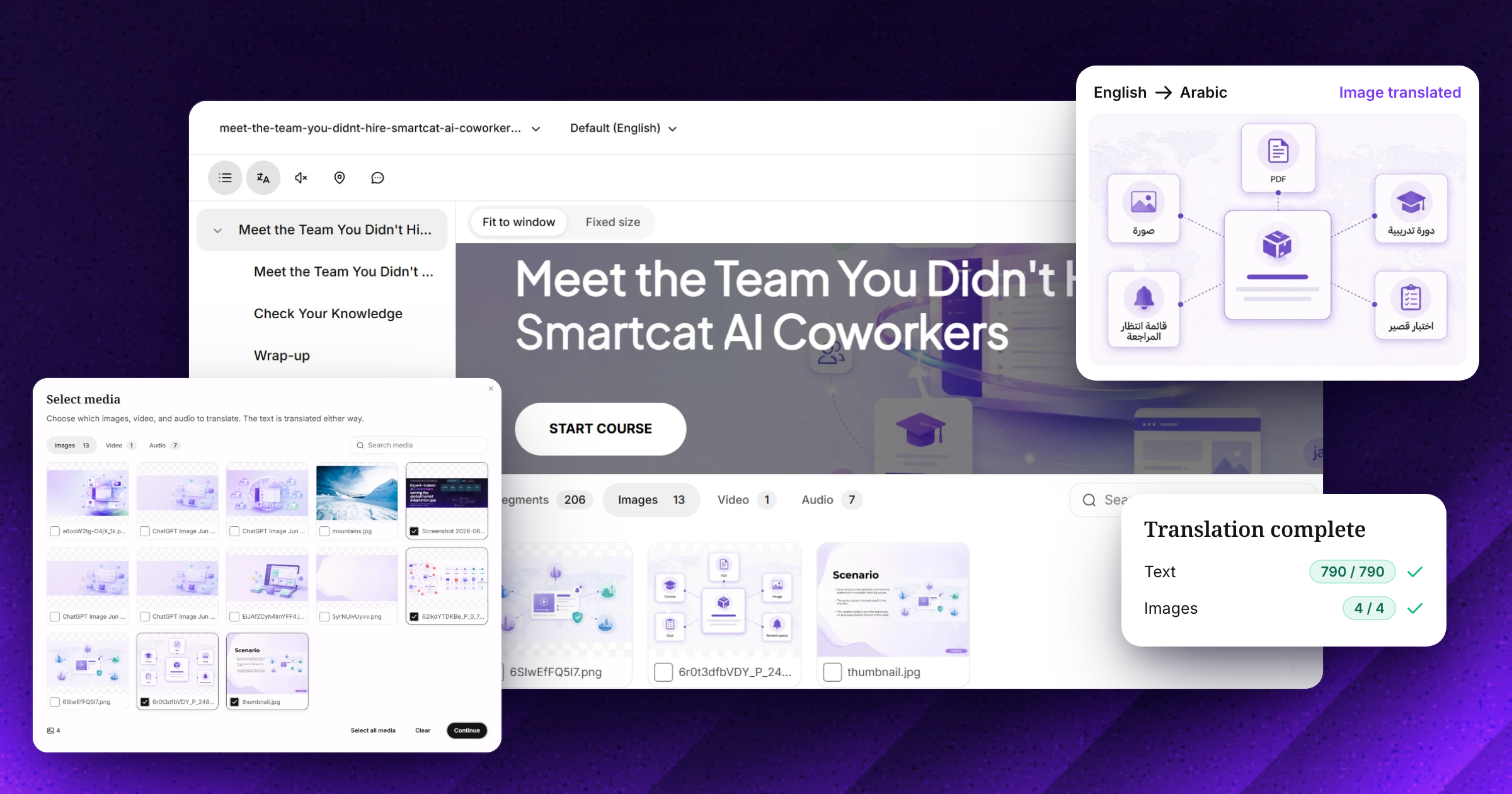
Translate the finished course directly, with your glossary applied, and send each language to a reviewer who knows the subject. That skips the slowest steps of the traditional workflow: exporting text, rebuilding each language in the authoring tool and re-testing every screen. Smartcat translates published SCORM courses with their quizzes, images and video (SCORM translation).
How the common approaches compare for compliance training, based on vendor documentation as of October 2026:
| Approach | Works well for | Watch out for |
|---|---|---|
| Full-service agency | Regulated content with no in-house reviewers | Every update goes back through the agency; RWS’s own guide says full localization takes weeks (RWS: eLearning localization guide) |
| LMS built-in translation | Courses built in that LMS’s own editor | Uploaded SCORM: 360Learning says SCORM content “cannot be translated using 360Learning’s AI” (360Learning: Globalization) |
| Authoring-tool localization | Courses built in that tool, when you have the source files | Articulate® Localization covers only content authored in its apps and doesn’t translate text in images or linked PDFs (Articulate: Localization FAQ) |
| Translation platform with review, such as Smartcat | Many languages, courses from several tools, frequent updates | Your team owns the approval workflow |
Can you use AI to translate compliance training and keep a human reviewer?
Yes. Let AI produce the first draft with your glossary and translation memory applied, then have a subject-matter expert review each language in the course itself before release. 92% of words translated by Smartcat AI are accepted without a single human edit, so reviewers spend their time on the sentences that carry legal or safety meaning.
- Build the glossary. Add regulated terms, product names and phrases that must stay fixed in every language.
- Translate with AI. Smartcat translates the course with your glossary and translation memory applied.
- Run an AI review pass. The Reviewer Coworker checks every language before people see it.
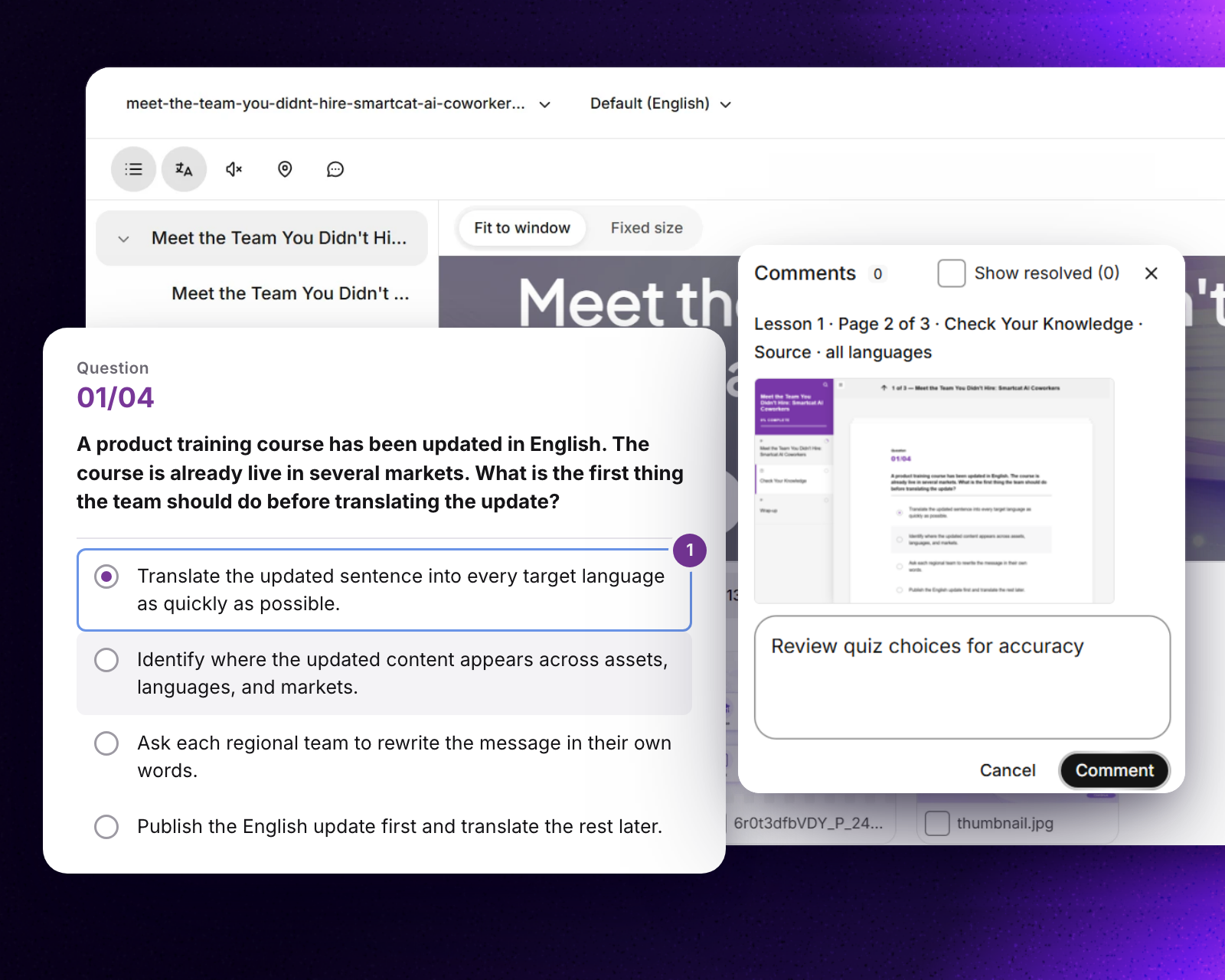
- Review in context. Subject-matter experts see each language exactly as learners will and comment on the screen.
- Add professional linguists where the risk is highest. Bring vetted linguists from the Smartcat Marketplace into the same project (eLearning translation services).
- Approve and export. Each language goes to the LMS only after its reviewer approves it.
“We don’t remove humans from the process; we reposition them to provide human review where edits are captured permanently.”
Nicole Morgan, Director, Global Sales and Service Enablement at Cummins Inc.
How can L&D teams stop waiting weeks for an agency to translate each course?
Move the first draft to AI and keep people for review. The weeks usually go to hand-offs: exporting text, waiting in the agency’s queue, rebuilding the course and re-testing it. Translating the published course in one Smartcat workspace removes most of those hand-offs, and translation memory means the next update starts from everything already approved. Cummins rolled out a program 90% faster this way.
Cost changes too: enterprise teams using Smartcat cut translation costs by 96% compared with traditional agency rates.
“We rolled the program out 90% faster and at a 90% lower cost.”
Nicole Morgan, Director, Global Sales and Service Enablement at Cummins Inc.
“I can put an e-learning course into Smartcat on Monday and have it back by Wednesday, Thursday at the latest, fully translated and ready to go.”
Michelle Quirke, Program Engagement Manager, Topcon
If an agency still handles some languages, invite its linguists into the same Smartcat project, so their work lands in your translation memory instead of in separate files.
How do you roll out mandatory training in 12 languages this quarter?
Translate the published courses instead of rebuilding them, start with the courses everyone must complete, and line up one reviewer per language before translation begins. With Smartcat’s AI drafting and in-context review, the timeline is set by review capacity, not by translation: Topcon’s team gets a course back two to three days after uploading it.
- Inventory and prioritize. List the mandatory courses and their deadlines; code of conduct, safety and data protection usually come first.
- Assign reviewers. Name one reviewer per language, such as a regional HR or compliance lead, before any translation starts.
- Translate the first wave into all 12 languages. Upload the SCORM packages and translate them with your glossary applied.
- Review and publish one language at a time. Don’t wait for the full set: publish each language as soon as it is approved.
- Repeat for the second wave. Translation memory reuses everything approved in wave one.
What’s the quickest way to translate onboarding courses after an acquisition?
Translate the onboarding courses you already run into the new team’s languages and have a manager from the acquired company review them. For a Latin American acquisition, that usually means Latin American Spanish and Brazilian Portuguese, each reviewed by someone who knows the local terms. Smartcat covers these regional variants among its 280+ languages.
- Pick the right variants. Latin American Spanish and Brazilian Portuguese differ from the versions used in Spain and Portugal.
- Start with day-one essentials: policies, systems access, safety and benefits.
- Reuse your glossary so company and product names stay consistent across both teams.
- Deliver one multilingual package so new and existing employees take the same course in their own language.
“Our learning library was built in English, which meant our Quebec workforce and other markets couldn’t fully engage with the content in their preferred language as fast as the business was changing. With Smartcat’s AI coworkers, our teams now adapt that content across languages much faster, ensuring our North America region stays current and consistent instead of waiting weeks to catch up.”
Jill Busch, Director, Learning and Development, ManpowerGroup
Which tools let subject-matter experts review translations before courses go live?
Look for review inside the course, not in a spreadsheet: reviewers should see each language as learners will, comment on the screen and approve it. Smartcat gives reviewers a live preview of the translated course, and their edits are saved to translation memory for the next update. Because 92% of words translated by Smartcat AI are accepted without a single human edit, reviewers spend their time on the rest.
That is still uncommon. Many translation management systems show course exports as text segments rather than slides; Phrase, for example, doesn’t list XLIFF among its in-context preview formats (Phrase: CAT editors (preview formats)). Articulate® Localization lets validators review in context with just an email address, for courses built in its apps (Articulate: Localization FAQ).
Which AI tool is best for translating compliance courses and onboarding modules?
The best tool is the one that covers your course formats and your approval process, not just the translation engine. Smartcat fits L&D teams that publish mandatory training in many languages: it translates complete courses, applies your terminology and routes every language to a reviewer.
Check any tool against these five questions:
- Formats: does it translate the published course, including quizzes, images and video, or only exported text? Smartcat translates 80+ file formats, from SCORM courses and PDFs to video.
- Languages: does it cover every language your employees use? Smartcat translates into 280+ languages.
- Review: can subject-matter experts review in context and approve each language?
- Linguists: can you add professional linguists for high-risk content? Even teams that rely mostly on human linguists save 81% compared with agency rates on Smartcat.
- Security: is it certified? Smartcat is SOC 2 Type II compliant and ISO 27001 certified (security).
A full-service agency can still be the better choice when no one in-house can review and you want the vendor to handle voice talent and LMS testing.
Try it on one of your compliance courses
Upload one mandatory course, translate it into the languages your employees use, and have a regional reviewer approve it in the course itself. Smartcat has localized more than 15,000 eLearning courses (training translation for L&D teams).
Frequently asked questions
Is AI translation accurate enough for compliance training?
AI handles the first draft well, but compliance training should never ship without human review. 92% of words translated by Smartcat AI are accepted without a single human edit; review catches the rest, especially terms with legal or safety meaning.
How do you show that each language was reviewed?
Assign a named reviewer to every language and release a language only after that person approves it. Keep the reviewer, date and version with the course record your compliance team already uses.
How do you keep translated compliance courses current when a policy changes?
Keep approved translations in a translation memory so only the changed sentences are translated and reviewed again. Deliver all languages from one multilingual package, or a Dynamic SCORM package that picks up approved changes without a re-upload (keeping translated courses current).
How much does it cost to translate compliance training?
It depends on volume, languages and how much human review you need. Even teams that rely mostly on human linguists save 81% compared with agency rates on Smartcat. Plans are on the pricing page, and the 15-day free trial includes 15,000 Smartwords.
Is training content secure in Smartcat?
Smartcat is SOC 2 Type II compliant and ISO 27001 certified. See security for details.
Is Smartcat affiliated with the companies named in this guide?
No. Smartcat is an independent platform and is not affiliated with, endorsed by, sponsored by or otherwise associated with any company or product named in this guide. All product names and trademarks are the property of their respective owners and are used solely for identification and comparison.
Related guides
Sources
- OSHA, Training Standards Policy Statement (April 28, 2010)
- RWS: eLearning localization guide
- 360Learning: Globalization
- Articulate: Localization FAQ
- Phrase: CAT editors (preview formats)

Maksym Ostapenko · Head of Product Growth, Smartcat
Maksym Ostapenko is Head of Product Growth at Smartcat, where he works on AI translation workflows, eLearning and enterprise localization. He writes about translation technology and localization operations from hands-on product experience.
Articulate®, Rise® and Storyline® are trademarks of Articulate Global, LLC. All other product names are trademarks of their respective owners. Smartcat is not affiliated with, endorsed by or sponsored by any company named in this guide; names are used solely for identification and comparison.