GDPR-compliant organization

ISO 27001 certified organization

SOC II compliant organization

Software Localization Platform and Services

Bring software strings, AI translation and language specialists into one software localization workflow. Keep your terminology consistent and return reviewed resources to the development process that ships your product.

Book a demo

Book a demo

Explore the workflow with your resource files, languages and release cadence

Start free trial

Start free trial

15 days free, no credit card

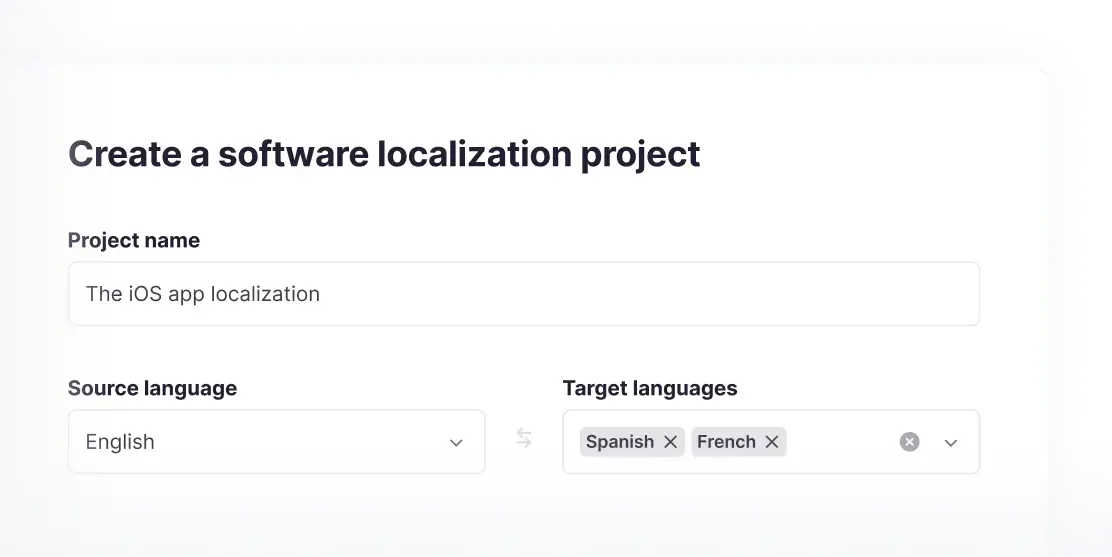
Creating a software localization project in Smartcat with source and target languages

More than 80 of the world’s largest companies have chosen Smartcat

What is software localization?

Software localization adapts a product’s interface, content and regional conventions for a specific language and market. It combines translation with work on formats, context and the way localized resources behave in the application.

A release is ready when the translated text makes sense and the product uses it correctly. That means preserving resource keys, supplying the right plural forms, formatting values for the locale and checking important screens. A localization platform organizes language work; your engineers and QA team integrate and validate the result.

ActivityMain questionExample
TranslationWhat does this text mean in another language?Translate an account-recovery instruction
Localization, or l10nDoes this product experience work in the target market?Adapt the instruction, date display and help link for that locale
Internationalization, or i18nCan the product support different locales?Externalize strings and use locale-aware formatting APIs

Internationalization creates the foundation. Localization uses it for each market. Treat both as recurring development work so every new feature can follow the same path.

Localize the product and the content around it

Users experience your interface, documentation and communications as one product. A shared glossary helps those touchpoints describe features in the same way, while separate briefs give each content type the right level of review.

ContentWhat to includeUseful context
Web and SaaS interfacesNavigation, forms, errors and notificationsScreenshots, key descriptions and user roles
Mobile appsiOS and Android resources, onboarding and store copyLength constraints, platform conventions and test builds
Desktop softwareMenus, dialogs, settings and installation messagesOperating-system context and resource structure
GamesInterface text, dialogue, tutorials and store descriptionsCharacter information, narrative context and terminology
Product documentationHelp articles, release notes and guidesProduct versions and links to the related interface
Customer communicationsProduct emails and support templatesTrigger conditions and the action a reader should take

For example, an error message needs more than a literal translation of “failed.” Reviewers should know what failed, whether the user can retry and what recovery options the product actually supports. Clear source content prevents confusion from spreading across every locale.

How software localization works in Smartcat

Smartcat connects resource management, translation and human review. Configure the integration and approval process around your existing release responsibilities.

  1. Scope the project

    Choose the product, source version and locales. Decide which content needs specialist review, who approves it and how translated output enters the build.

  2. Import the resources

    Upload supported files or configure an integration, API or CLI workflow. Software localization projects organize keys in collections. Keep source identifiers stable so updates can be tracked consistently.

  3. Provide context and language assets

    Add product terminology, previous approved translations and instructions. Supply descriptions, screenshots and length metadata where the chosen workflow supports them.

  4. Translate and review

    Use AI translation to create the draft, then assign your own reviewers or Marketplace specialists. Reviewers resolve ambiguity and ensure the language matches the product and audience.

  5. Assess quality and approve

    Use automated language assessment alongside human checks. The QA Coworker classifies translation issues and measures quality; your team decides whether the content meets the agreed release criteria.

  6. Export, test and repeat

    Return localized resources to development, validate the format and run application tests. Configure the next source update to follow the same controlled process.

Read the software project setup guide. For a custom integration, use the software localization developer documentation.

Map your release workflow with Smartcat

Software localization tools for each stage

The useful tool is the one that removes a specific handoff or makes a decision easier to review. Start with the tasks your team performs most often.

Manage resources without losing their meaning

Collections organize source keys and translations. Documented software-project formats include JSON, YAML, Android XML and iOS .strings; LocJSON imports can include comments and maximum-length metadata. Test your exact structure, especially plural and placeholder conventions, before processing an entire product. PO/POT localization is described in Smartcat’s existing software workflow. Confirm the appropriate project path for those files rather than treating every supported document format as interchangeable with a software collection.

Documented software-project formats

JSONYAMLAndroid XMLiOS .stringsLocJSON

Reuse terminology and approved language

A glossary records the names and terms your product needs to use consistently. Translation memory makes previously approved translations available for reuse. Maintain these assets as the product changes: a renamed feature should have an owner and an explicit migration decision, not a series of contradictory reviewer edits.

Connect language work to development

Explore the integration directory for Git and content workflows. The API and CLI support teams with custom orchestration needs. Define the trigger, branch strategy and return path during implementation; a connected repository alone does not establish a complete release pipeline.

Review designs before strings reach production

The Figma workflow helps connect design content and translation. Review an expanded label while there is still time to change the design. A design check complements, but does not replace, testing in the actual application with its fonts and responsive behavior.

Make quality decisions visible

The Quality Assurance Coworker identifies translation issues and produces a quality score. Native reviewers add context and market judgment. Keep the score, corrections and approval responsibilities distinct so a numerical result is never mistaken for a successful application test.

GitHub Translation Plugin

Automate and streamline translation workflows for GitHub projects.

Git Translation for Android

Effortlessly translate and localize Android apps directly from Git.

Git Translation for iOS

Seamlessly translate iOS apps within Git for global distribution.

Prepare your software for localization

An internationalization checklist helps engineering remove obstacles before translation begins. Use the platform and framework documentation for implementation details.

Internationalization checklist

Remove these obstacles before the first strings go to translation.

  • Externalize user-facing text instead of embedding it in application logic.
  • Use stable resource identifiers and meaningful descriptions.
  • Keep complete fallback resources for the default language.
  • Use locale-aware APIs for dates, numbers, currencies and units.
  • Build full messages rather than concatenating translated fragments.
  • Use your framework’s plural rules and preserve placeholder types.
  • Support text expansion, different scripts and appropriate fonts.
  • Use directional layout properties for right-to-left interfaces.
  • Keep language selection predictable and test fallback behavior.
  • Run pseudolocalization and test representative real translations.
  • Include error states, empty states and accessibility labels in the resource scope.
  • Connect the approved resource version to the build you actually test.

For a small example, “You have ” + count + “ messages” assumes English word order and grammar. A complete plural message gives each target language control over the sentence while preserving the count as a variable.

A platform, AI translation and the reviewers you choose

Software localization services provide language expertise; software localization tools organize the work. Smartcat lets you combine a platform and AI translation with your existing linguists or specialists selected through the Marketplace.

Your situationA practical workflow
You already have an internal language teamKeep your reviewers and centralize terminology, resources and approvals
You are adding markets without internal coverageScope the work and select reviewers with the relevant language and product expertise
You work with an agencyKeep the agreed service relationship and define how the agency works with your shared assets and release process
You need to validate the approach firstRun a representative pilot with a few important flows before connecting larger releases

Choose review depth according to the content. A marketing slogan, a security warning and a routine menu item require different judgment. Explain those differences in the brief rather than expecting one uniform setting to produce the right result everywhere.

Explore translation and localization services or find language specialists.

Explore your software localization workflow

Mobile apps

Connect interface resources, onboarding and store content. Localize your mobile app.

Android

Prepare strings.xml, preserve format arguments and review translations in the build. Explore Android localization.

Flutter

Understand ARB messages, intl and generated localization code before defining the translation handoff. Read the Flutter guide.

Localization testing

Combine linguistic review with checks of text layout and locale conventions. Plan your localization testing.

Web, SaaS and desktop products

Start with the supported resources your application uses, then scope language review around the important user journeys. Include documentation and support content in the same terminology plan.

Games

Give reviewers character, narrative and gameplay context. Language review supports the experience; gameplay and performance testing remain part of game QA.

Evidence from a connected translation operation

298

projects across 29 countries

Topcon’s team delivered 298 translation projects in two years, covering 31 languages, and cut one eLearning course’s turnaround from 13 hours to 11, with about two more hours saved per course through automated project setup.

Topcon’s published customer story describes replacing a fragmented setup involving eight translation vendors with one platform. The relevant lesson for a software team is operational: shared assets and responsibilities can be easier to manage when the language work is connected. Read the Topcon story.

Use your own pilot to establish product-specific outcomes. Measure the time from source update to approved resources, reviewer effort, terminology exceptions and defects found in the localized build. Keep content scope and language mix comparable when evaluating the result.

Pricing and a practical starting point

What drives the cost

Your cost depends on content volume, target languages, review requirements and the workflow you configure. Check Smartcat’s current plans and request separate quotes for external linguistic work where needed.

How to start

Bring a representative resource file, a glossary and a few important screens. Include variables, long labels and plural messages. Agree on success criteria before the pilot: valid exports, clear language, traceable approval and a build your QA team can test.

Frequently asked questions

What is software localization?

Software localization adapts an application for a language and market. It includes interface translation, regional formats and the way localized text works in the product. Developers prepare and validate the application, while linguists and reviewers check meaning, terminology and market suitability.

How does localization differ from internationalization?

Internationalization prepares software to support multiple locales. Localization creates and validates a particular locale’s experience. Externalizing strings is internationalization; producing the German version and checking its labels and formatting is localization. Both need maintenance as the product evolves.

What types of software can be localized?

Web applications, SaaS products, desktop software, mobile apps and games can all require localization. The workflow depends on the resource format and framework. For iOS and Android release requirements, explore mobile app localization.

Which resource formats are supported?

Smartcat documents JSON, YAML, Android XML and iOS .strings for software projects, with LocJSON available for imports carrying additional metadata. Check the exact format and project path with a sample round trip. Framework-specific extensions and plural conventions need validation before production use.

Can we automate software localization?

You can connect supported integrations or use the API and CLI to automate parts of the workflow. Define source triggers, review gates, exports and version-control behavior during setup. Automation moves resources; it does not remove the need for approval rules or tests of the localized application.

Can we use our own translators?

You can build the workflow around your existing language team and add external specialists where required. Agree on responsibilities, terminology ownership and approval criteria. A shared workspace is most useful when everyone knows which content they own and what qualifies as complete.

How do you check translation quality?

Combine language assets, AI quality assessment and human review. Smartcat’s QA Coworker classifies issues and scores translation quality, while reviewers resolve context and wording decisions. Your engineering and QA teams still validate resource behavior, layout and functionality in the application.

Is software localization the same as website translation?

They overlap, but the implementation differs. Software localization works with application resources and the build process. Website translation may work with a CMS or published page content. Choose the workflow according to how your content is stored, rendered and released, not simply whether users see it in a browser.

How much do software localization services cost?

The scope determines the cost: languages, source volume, repeated content, specialist review and integration requirements. Review platform pricing and external reviewer quotes separately. Include internal engineering and QA work when comparing the overall effort with your current process.

Didn’t find your answer? Talk to a localization specialist

Make localization part of the way you ship software

Connect one resource set, agree on review criteria and see the complete path from source text to a validated localized build.